
A listing near Little Paw Paw Lake made its pitch without much subtlety this spring: get the lake life without the lakefront price tag, steps from the water. It is the kind of line that could easily read as marketing filler. It also points to a useful distinction when comparing properties around Coloma.
Paw Paw Lake gets marketed as the affordable alternative to South Haven and St. Joseph, and on paper that holds up. But the median price everyone quotes for Paw Paw Lake is not describing one market. It is blending two products that share a shoreline and very little else: true lake frontage, and deeded or across-the-street access. Treating them as the same thing can obscure important differences between frontage and access properties.
Two products, one lake
Paw Paw Lake and its smaller neighbor, Little Paw Paw Lake, sit across parts of Coloma Charter Township and Watervliet Township, an 857 to 900 acre all sports lake depending on whose survey you trust, with roughly 9 miles of combined shoreline. Along that shoreline you will find a handful of very different ownership arrangements sold under the same "Paw Paw Lake" heading.
At the top end sits true frontage: homes and cottages that own the shore directly, with private docks, lifts, and enough footage to matter. A recent listing on 70 feet of frontage, another on 85 feet with a sandy beach, a build-ready peninsula lot on Ellinee Bay with 130 feet, these are the properties driving the lake's headline waterfront numbers.
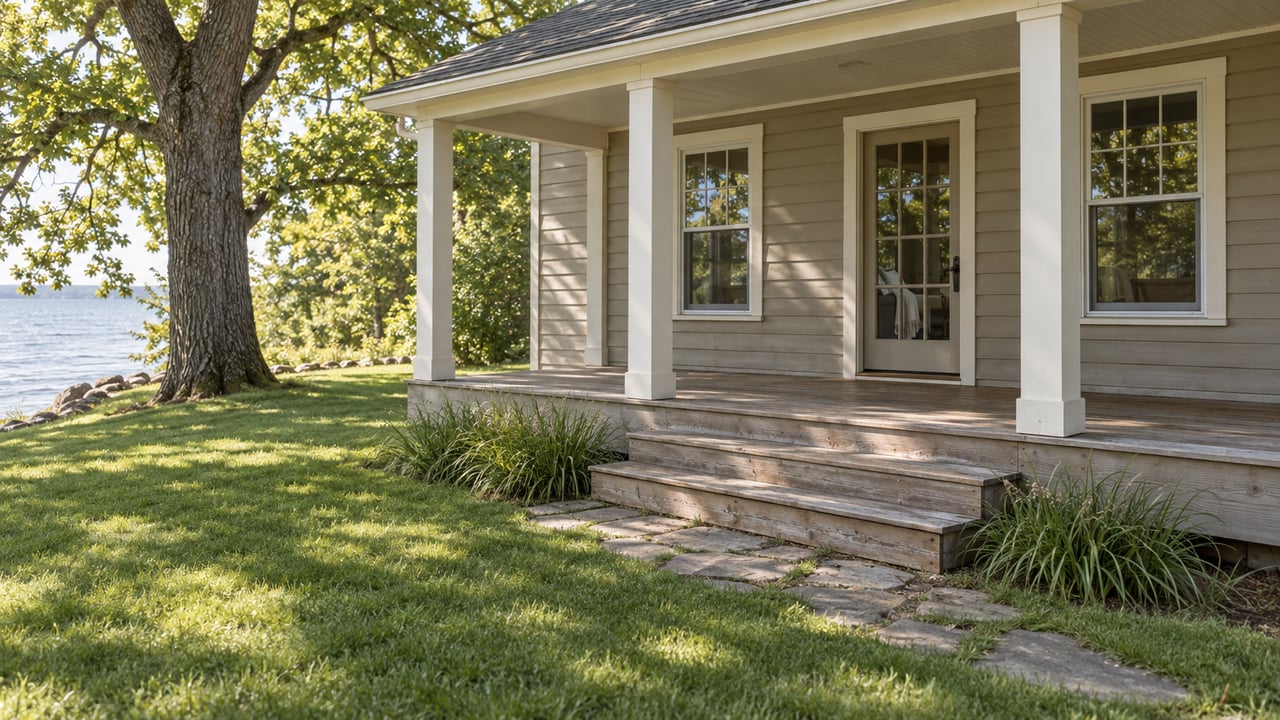
One step down, and often priced very differently, sits deeded or across the street access. Several current listings on Little Paw Paw Lake describe a strip of shoreline, commonly 33 to 67 feet, located across the street from the actual house. The living space itself is set back from the water. It is not the same experience as owning frontage under your own back deck.
Then there are the community access arrangements. Yacht Club Point advertises access to the lake rather than private frontage. The gated Nature's Cove community sells lots with a deeded boat slip and shared clubhouse, pool, and court access rather than individual shoreline. Chalet du Paw Paw, a condo community, bundles a short walk to an association beach, tennis courts, and a boat slip into the HOA rather than the deed. Each of these is a legitimate way to live on the lake. None of them is interchangeable with the others when it comes to price, resale, or what you can actually do with the water.
What the deed is actually granting you
Before comparing prices, it helps to know what each tier typically includes:
- True frontage — shoreline directly in front of your home, often with a private dock or lift.
- Deeded or across the street access — a separate shoreline strip (often 30 to 70 feet) across the street from your living lot, while your home itself sits off the water.
- Association or community access — access to the lake through shared amenities such as a boat slip, beach, or clubhouse, rather than individual shoreline.
That last distinction matters more than it sounds like it should. Read the HOA documents closely before you assume a boat slip is guaranteed for the life of your ownership.
What each tier is actually costing
Here is where the numbers get interesting, and where the "affordable lake town" story starts to fray a little.
| What you're looking at | Price signal | What it reflects |
|---|---|---|
| True Paw Paw Lake frontage | Median listing price around $469K, based on 22 waterfront homes on the market as of late August 2026 | Private frontage, often 70 to 130 feet, typically with a private dock or lift |
| Coloma waterfront, broader search | Median listing price around $230K, based on 19 waterfront listings in the same window | A wider net that includes smaller lots, access parcels, and properties further from the most built-up shoreline |
| Paw Paw Lake overall (all inventory) | Roughly $267,500 to $375,000 this year | Blends frontage, access, and non-water homes across the whole lake community |
| South Haven, for comparison | Around $319,000 | Lake Michigan proximity with a more resort-scale downtown |
| St. Joseph, for comparison | Roughly $300,000 to $460,000 | Bluff-top and downtown lakefront premium |
Look at the spread inside Coloma alone. A search for "Paw Paw Lake waterfront" returns a median near $469K. A search for "Coloma waterfront" returns a median near $230K, using a nearly identical listing count. Those are not two different lakes. They are two different definitions of what counts as waterfront, one weighted toward true frontage and marina-adjacent lots, the other pulling in a wider mix of access parcels and smaller cottages. If you only see one of those numbers on a portal, you are seeing half the story.
Then there is the volatility that comes from Coloma being a genuinely small market. City-wide sales data through April 2026 showed a median sale price down sharply year over year, with only two homes sold that month and the typical time on market stretching to 165 days, more than double the prior year's pace. A different tracker, pulling August 2026 listing data, showed the opposite direction entirely: a median asking price up over a third year over year, with days on market cut nearly in half. Both can be technically accurate. Neither is describing a stable trend. When a market this size only closes a handful of homes in a given month, one unusually expensive frontage sale or one batch of modest access cottages can swing the median by tens of thousands of dollars without the underlying market actually moving. That is the real lesson buried in the data: in Coloma, the headline number tells you less than the property type does.
How township rules affect rentals
Paw Paw Lake sits across two separate municipalities.
Coloma Charter Township and Watervliet Township, which also borders the lake, are the local jurisdictions to check about rental use. If you are buying with rental income in mind, review the relevant requirements before you make an offer, not after closing.
What this means if you're comparing lake towns
If you are cross-shopping Coloma against South Haven or St. Joseph using median price alone, you are comparing a blended, volatile number against two markets with more consistent inventory. The better question is not "what does Paw Paw Lake cost," but "which tier of Paw Paw Lake am I actually looking at." A frontage home priced near $469K is competing directly with entry-level St. Joseph waterfront. A deeded access cottage on Little Paw Paw Lake is a genuinely different product, priced differently, and worth evaluating on its own terms rather than as a discount version of frontage.
Is deeded lake access the same as owning waterfront? Not quite. A deeded access property is different from a home with its living lot on the water.
Do association access properties come with guaranteed boat slips? That depends on the specific community; check its documents and listing details for what is included.
Does it matter which township a Paw Paw Lake property sits in? For day to day living, not much. For rental income, check the requirements for the specific property before you buy.
If you are weighing frontage against access, or trying to figure out which side of the township line makes sense for how you actually plan to use the property, that is exactly the kind of local detail worth a real conversation before you start touring. Andrea Hook-Graham works this stretch of Southwest Michigan lake country directly and can walk through what a specific listing's deed and township actually mean for your plans. Let's Connect.
This article is general information, not legal, tax or financial advice. Consult a qualified professional about your situation.